AIO stands for AI optimization. It’s the work of getting your business named, quoted and linked in the answers AI tools give people: Google’s AI Overviews and AI Mode, ChatGPT, Perplexity, Microsoft Copilot and Gemini. Instead of only trying to rank as a blue link, you’re trying to be the source the AI pulls its answer from.
(If you landed here looking for AIO coolers or all-in-one computers, wrong AIO. This one is about marketing.)
I’m Bobby, and I run ADK SEO REV out of Glens Falls. Over the last six months I took an online store called Conservation Mart from 0 Google AI Overview citations to 1.1K, and from 54 AI responses to 1.5K across every major AI platform. Below I’ll explain what AIO actually is, whether your business needs it, and exactly what I did for Conservation Mart, because the same playbook works for a plumber, a restaurant or a law firm here in the 518.
What AIO means in marketing
When someone types a question into Google today, there’s a good chance the first thing they see is an AI Overview: a short, AI-written answer at the top of the page with a few source links beside it. Ask ChatGPT or Perplexity the same question and you get a similar answer with its own list of sources.
AIO is the practice of making your website one of those sources. When it works, the AI mentions your business, summarizes your content, or links to your page as the place it got the answer.
Where AI answers show up
- Google AI Overviews: the AI summary at the top of regular Google results. This is the one most of your customers see.
- Google AI Mode: Google’s chat-style search tab.
- ChatGPT: more people use it like a search engine every month.
- Perplexity: an AI search engine that cites its sources heavily.
- Microsoft Copilot: built into Windows, Edge and Bing.
- Gemini: Google’s AI assistant, including on Android phones.
AIO vs SEO: what’s the difference?
SEO (search engine optimization) is about ranking your pages in search results. AIO is about getting your content used inside AI answers. You’ll also hear AEO (answer engine optimization) and GEO (generative engine optimization). They’re different names for roughly the same goal.
Here’s the part a lot of agencies won’t tell you: AIO is built on SEO. Google’s own guidance on AI features says there are no additional requirements or special optimizations needed to appear in AI Overviews or AI Mode. Your page has to be indexed and eligible to show in Google with a snippet, and normal SEO best practices still apply. You don’t need special AI files or secret markup.
So what’s different? The content. AI tools are answering questions, so they favor pages that answer questions clearly, in plain language, with enough context to be trusted. A thin page with two sentences and a “Buy Now” button gives an AI nothing to work with. A page that explains what something is, who it’s for and how it works gives it plenty.
Does my business need AIO?
If your customers search before they buy, yes. That covers almost every local business I work with.
Think about how people actually search now. They don’t type “plumber Glens Falls” as often as they used to. They ask “why is my water heater making a popping noise?” or “how much does a roof replacement cost in upstate New York?” Some ask out loud, through Siri, Alexa or their car. The AI answers the question, and the businesses whose websites provided that answer get named.
If your website doesn’t answer those questions, somebody else’s does. That’s usually a competitor, or a big national site that doesn’t care about your town.
You need AIO most if:
- Your organic traffic has been slipping and you can’t figure out why
- Your website hasn’t been touched in years
- Your service or product pages are a sentence or two long
- A previous SEO company filled your site with generic AI-written content
- Your competitors are showing up in AI Overviews and you’re not
How AIO got Conservation Mart 1.5K AI responses and 1.1K AI Overviews
Conservation Mart is an online store that runs on BigCommerce. Here’s what the project looked like from start to finish.
Where they started
When I started, Conservation Mart had 54 AI responses across all platforms and zero Google AI Overview citations. Organic traffic had been dropping since Google’s August 2025 spam update, which finished rolling out in late September 2025. That update went after low-value and mass-produced content. The owner brought me in to take a look, and we started with a full audit.
What the audit found
The technical side of the site was mostly sound. The content was the problem:
- Hundreds of zombie and orphan pages. Zombie pages are low-quality pages that get little or no traffic and drag down the rest of the site. Orphan pages have no internal links pointing to them, so Google has a hard time finding or valuing them.
- Thin category and product pages. Many pages had almost no content.
- ChatGPT copypasta. Other pages were filled with generic AI-written text left behind by his previous SEO team. Lots of words, very little real meaning.
- No rich contextual language. Most pages didn’t explain the products in the natural way people actually talk and search.
- 404 errors that needed cleaning up.
Step 1: Clean up the site
Most of the zombie and orphan pages were low quality with nothing worth saving, so I deleted them. Hundreds of them. Most received a 410 status, which tells Google the page is gone for good. A 404 only says “not found,” so Google keeps checking back. A 410 gets dead pages out of the index faster, so Google spends its time on the pages that matter. I also cleaned up the 404 errors.
Once that cleanup was finished, about a month in, we started seeing gains almost immediately.
Step 2: Rewrite the category and top product pages
This is where the real AIO work happened. Every category page and several of the store’s top-performing product pages got a complete rewrite built from a full semantic outline.
A semantic outline maps out everything a page needs to cover for its topic: the questions people ask, the terms and related concepts that belong with it, and the order that makes sense to a reader. It’s my secret sauce, and it’s the difference between a page that mentions a keyword and a page that actually covers the subject. AI tools reward the second kind.
BigCommerce limited what we could do with page design, so we couldn’t rebuild the layouts. We didn’t need to. We added extensive content to each page and rewrote all of it in natural language, the way people speak when they ask a voice assistant or type a question into ChatGPT. I started with the category pages because they carry the most weight on an online store.
Step 3: Add FAQs and schema to every page
Every page got a set of frequently asked questions and proper schema markup. FAQs give AI tools short, direct answers they can lift. Schema is code that tells search engines exactly what’s on the page: a product, a category, a list of questions and answers.
Step 4: Clean up the blog
Next came the blog. Some older posts were still ranking well, so I left those alone. If something’s working, don’t break it. Others were rewritten or cleaned up.
Step 5: Fix the internal linking
We put a lot of stock in internal linking. Product pages now link up to their category pages, and some category pages link back down to key products. That gives Google and AI crawlers a clear map of how the store fits together and which pages are the most important. It’s also part of how you fix orphan pages: a page nothing links to barely exists.
The results
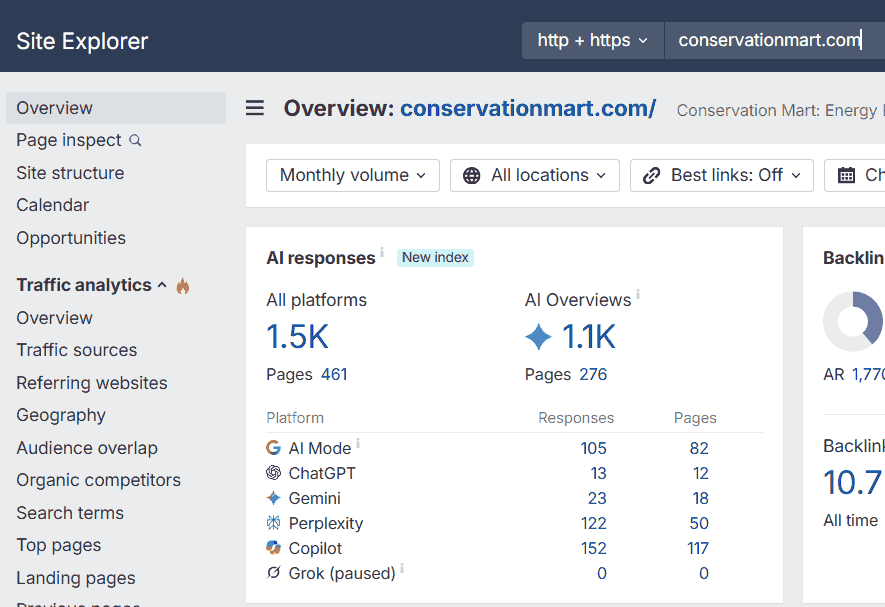
Gains started right after the audit cleanup, about one month in. Around month two, things really took off. Six months after we started, according to Ahrefs:
- 1.5K AI responses across all platforms, citing 461 pages (up from 54)
- 1.1K Google AI Overview citations across 276 pages (up from 0)
- 152 Microsoft Copilot responses, 122 from Perplexity, 105 from Google AI Mode, 23 from Gemini and 13 from ChatGPT
The AI numbers weren’t the only thing that moved. Rankings and clicks went up too. Conservation Mart’s revenue is up about 30% year to date, and the store has already passed its total revenue for all of 2025, with more than two months left in the year.
The site has also gotten stronger with every Google update since the cleanup and rewrites. That’s the payoff for doing it the right way: when Google raises the bar, you’re already over it.
The same AIO playbook works for local businesses
Conservation Mart is an online store, but nothing above is specific to ecommerce. If you run a business in Glens Falls, Queensbury, Lake George or Saratoga, it’s the same playbook.
1. Clean up your site technically
Fix broken pages and 404 errors. Get rid of pages that serve no purpose. Make sure Google can crawl and index the pages you care about. If your site is slow, broken on phones or full of dead links, no amount of content will save it.
2. Stop serving the old junk content
Be honest about what’s on your site. That service page you wrote in 2020 and never touched, the blog posts somebody’s nephew wrote, the AI-generated filler from the last company you paid. If it’s thin, outdated or generic, rewrite it or remove it. Google’s spam updates are getting better at spotting low-value content, and AI tools won’t quote it.
3. Write question-and-answer blog posts
Write posts that answer the real questions your customers ask you on the phone, at the counter or on the job. “How long does a furnace last?” “Do I need a permit for a deck in Queensbury?” “What should I bring to my first appointment?” Answer the question clearly at the top, then explain it in plain language. That’s exactly the kind of content AI Overviews pull from. It’s also how this post is written.
4. Add FAQs, schema and internal links
Put a short FAQ section on your main service pages, mark it up with schema, and link your pages together so your blog posts point to the services they relate to. Same thing I did for Conservation Mart, at local-business scale.
AIO mistakes I see most
- Pasting in ChatGPT content. Generic AI text is exactly what got Conservation Mart into trouble. AI tools don’t need to quote your website saying the same thing they could have written themselves.
- Keeping every old page “just in case.” More pages isn’t better. Hundreds of weak pages dragged Conservation Mart down until we removed them.
- Chasing gimmicks. Google says you don’t need special AI files or markup to show up in AI Overviews. Anyone selling you a magic AI trick is selling you a trick.
- Expecting overnight results. Conservation Mart saw early gains after a month and real momentum after two. That was fast. Plan on months, not days.
How to tell if your business shows up in AI answers
- Google the questions your customers ask and see whether your site is linked in the AI Overview.
- Ask ChatGPT, Perplexity and Copilot the same questions, including ones with your town name, and check the sources they list.
- Use a tool like Ahrefs, which tracks AI Overview citations and AI responses across platforms. That’s where the screenshot above comes from.
Frequently asked questions about AIO
What does AIO stand for in marketing?
AIO stands for AI optimization. It means making your website a source that AI tools like Google AI Overviews, AI Mode, ChatGPT, Perplexity, Copilot and Gemini use and cite when they answer people’s questions.
Is AIO the same as SEO?
AIO is built on SEO. Google says there are no special requirements to appear in AI Overviews beyond being indexed and eligible to show with a snippet. The difference is focus: AIO puts more weight on content that answers questions clearly and completely in natural language, plus FAQs, schema and strong internal linking.
How long does AIO take to work?
For Conservation Mart, gains started about a month in, right after the audit cleanup, and results took off around month two. Six months in, the store had 1.1K Google AI Overview citations and 1.5K AI responses. Every site is different, so plan on months, not days.
Can a small local business show up in Google AI Overviews?
Yes. AI Overviews pull from pages that answer the question well, not just from big brands. A local business with a clean website, helpful service pages and question-and-answer blog posts can be cited, especially for questions that include its town or service area.
Will AI-written content help me show up in AI answers?
Generic AI-written content usually hurts more than it helps. Conservation Mart’s previous SEO team filled pages with ChatGPT text, and those pages had zero AI Overview citations. Rewriting them in natural language from a full semantic outline did.
What is the first step in AIO?
Start with an audit. It shows which pages are thin, outdated, broken or orphaned, so you know what to fix, rewrite or remove before writing anything new.
Want to know if AIO can work for your business?
I’ll take a free 10-minute look at your website and tell you the two or three biggest things keeping you out of Google’s AI Overviews and AI answers. No pressure and no long sales pitch. Fill out my contact form here and I’ll get back to you.